http://fakesteve.blogspot.com/2007/08/stunning-post-from-microsoftie.html
Wednesday, August 29, 2007
Microsoft employee says (anonymously on FakeSteve) that Vista is just *not good*
Makes me even happier I switched to Mac...


Java DB: It's both embedded *and* a server
Some emails I have been reading indicate that not everyone knows there is this cool feature in Java DB/Derby. With a simple call in Java or by setting a property, you can have a VM with an embedded Derby database that also allows other processes to connect to and use this database through the network JDBC driver.
The instructions on how to enable the network server are here.
You either set the property
Pretty darn simple...
The instructions on how to enable the network server are here.
You either set the property
derby.drda.startNetworkServer=true in your derby.properties file or you can start it explicitly:
NetworkServerControl server = new NetworkServerControl();
server.start (null);
Pretty darn simple...
Tim Boudreau moves, with flash and fun
Tim Boudreau is quite a character, and this latest foray, driving a NetBeans truck he painted himself across country as he relocates from the West Coast to the East Coast, is just plain fun and cool.
http://weblogs.java.net/blog/timboudreau/archive/2007/08/the_netbeansmob.html
Jet Lag program was a success!
I applied the jet lag program I had recommended here, and I also supplemented it with Damon's acupressure/affirmation program that he referred me to in a comment.
Thanks, Damon, that really worked! Another benefit of blogging :) It's right up my alley (being from Berkeley).
Something about pressing all those points and reminding myself to feel good -- I found myself relaxing, breathing better, and feeling refreshed. I had zero jet lag in both directions, on a five day trip. I didn't sit up wide awake in the middle of the night or collapse in the middle of the day.
Yes, it sounds all wooey/New Agey, but hey, I am an open-minded scientist type and will try anything that doesn't sound harmful or cultish. Before you pooh-pooh it, try it yourself.
Thanks, Damon, that really worked! Another benefit of blogging :) It's right up my alley (being from Berkeley).
Something about pressing all those points and reminding myself to feel good -- I found myself relaxing, breathing better, and feeling refreshed. I had zero jet lag in both directions, on a five day trip. I didn't sit up wide awake in the middle of the night or collapse in the middle of the day.
Yes, it sounds all wooey/New Agey, but hey, I am an open-minded scientist type and will try anything that doesn't sound harmful or cultish. Before you pooh-pooh it, try it yourself.
Prague Trip

OK, Heathrow was hell, but Prague was quite wonderful. I actually was able to get away from the office on Friday afternoon and take a walking tour of Prague. I highly recommend Prague Walks They have all sorts of walking tours - the one I took was three hours with a very knowledgeable guide and included a stop half-way through at a pub for a foot rest and a local beer. What a great way to spend three hours!
More photos can be found here. They're with my crappy cell phone camera, I forgot to bring my regular camera (probably a good thing because it would probably still be sitting in Heathrow in my lost suitcase), but there are some good shots in there considering.
Tuesday, August 28, 2007
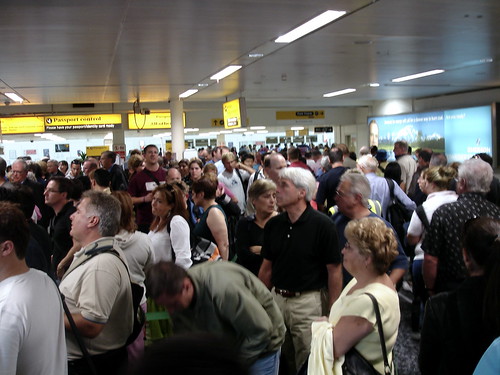
Heathrow Hell
 |  |
I remember seeing Simon Phipps links about Heathrow, but didn't really pay attention. I didn't have any idea how bad it could be.
When you exit in England, you simply go out, get your baggage (although that did take 45 minutes), catch the Heathrow Express, and you're good to go. On the way back in, you go through security and on to your plane.
Ah, but when you're transferring flights, it's an entirely different, and hellish, experience. There is no one international terminal, so you have to be shipped from terminal to termnal on a bus. Our bus got stuck behind a luggage cart that had lost its luggage. Their transfer stations are completely overwhelmed, and it takes an hour to get a boarding pass for your next leg of the flight. Worst of all, the UK doesn't trust any other country's security and you have to go through a security check even though you went through one at your original departing airport. And this security is completely overwhelmed and the line is (if you're lucky) 45 minutes to an hour long.
The worst part of this was that I got the sense that the staff there really didn't really care if this was an inconvenience, it's just the way it is. And at Virgin Atlantic, when they were continually screwing up my ticket, they kept intimating it was my own misunderstanding of the arcane rules of airport/airline bureaucracy that was causing the problems. Deal with it, passengers, it's not our problem, was the general feeling.
As a result of the delayed flight and eternal security line, I missed my connection. So, I get put on a BA flight. Back to Terminal 1, the terminal I started at. And guess what, I have to back through friggin' security because I have been "mixed" with unchecked passengers. And nobody seems to think that maybe, just maybe, there could be a better way. Deal with it, passengers.
I checked at the gate to make sure my luggage had followed me, and they assured me it had. When I get to SFO, no luggage. Since then I have been calling every day, and today they told me that it often takes a month for someone to get their baggage back. A MONTH!. I was this close to packing my laptop on that suitcase...
I can just see the folks at Heathrow standing around, hands in pockets, taking a break, not really caring, and my luggage just sitting there. Someone glances over at the bag. "Who's luggage is that?" someone asks. "Dunno." says someone else and shrugs. Oh well... Not my problem...
Heathrow is an old, massive, airport, that is completely overwhelmed. This I understand. But the general apathy of the folks working there, the complete disregard for passengers, is unforgivable. They should have a sign over the airport as you come in: "Deal with it."
I was complaining to one of the people helping me with my lost luggage about Heathrow, and she said she personally will not go into Heathrow as a passenger, at least until the build their new terminal. A flight attendant on the BA flight also confirmed that Heathrow is absolutely hellish and to be avoided.
So Heathrow is permanently on my black list. I hope some day the airlines realize they are losing customers because of Heathrow, and start making deals with alternate airports. I hope some day Heathrow realizes that passengers are actually what they are there for, and without passengers, you have no airport.
Personally, I am one passenger they have lost, and I'll also be telling anybody else I know to avoid Heathrow at all costs as a transfer destination. If I am transferring in Europe, I will go through any airport other than Heathrow.
Deal with it, Heathrow.
P.S. Reading the comments on Tim's blog about Heathrow, it sounds like Frankfurt and Amsterdam are great choices, and that Paris, Gatwick and Stansted are all pretty close to Heathrow in terms of pure yuck.
Rick Hillegas talks to us about Java DB
A nice quick podcast where we get to hear Cloudscape old-timer Rick Hillegas talk about Java DB. The interview with Rick starts about 6 minutes in. Really direct, informative podcast.
http://today.java.net/pub/a/today/2007/08/27/javamobility-podcast17.html
Friday, August 24, 2007
Password encryption in Derby 10.3
A reader asked if password encryption is enabled by default in 10.3. I checked with the Derby team, and the answer is, no, the password is still sent in the clear by default in 10.3. You have to enable it by setting the
See http://db.apache.org/derby/docs/dev/ref/rrefattribsecmech.html for more details.
securityMechanism property on the URL.See http://db.apache.org/derby/docs/dev/ref/rrefattribsecmech.html for more details.
English Cheddar in the Colonies!
In response to my post about the London Cheese Shop (no, not the Monty Python Cheese Shop, they actually have cheese, including Cheddar, and they weren't playing a bloody bazouki), my sister posted info on the name of the shop and their web link, and my Pa then found a US purveyor.
Elizabeth:
The shop is Neal's Yard Dairy - the cheeses are locally produced English ones with the names of the farmers on them! Here's the website:
http://www.nealsyarddairy.co.uk/thecheeses.html#
David tried the Montgomery Cheddar, if you click the link you can see more pictures.
Me dear ol' Pa:
Not only that -- I went to the website and found that they retail in the USA via select fromageries. Voila! Montgomery cheddar!
http://www.bedfordcheeseshop.com/catalog/?id=33
Elizabeth:
The shop is Neal's Yard Dairy - the cheeses are locally produced English ones with the names of the farmers on them! Here's the website:
http://www.nealsyarddairy.co.uk/thecheeses.html#
David tried the Montgomery Cheddar, if you click the link you can see more pictures.
Me dear ol' Pa:
Not only that -- I went to the website and found that they retail in the USA via select fromageries. Voila! Montgomery cheddar!
http://www.bedfordcheeseshop.com/catalog/?id=33
Fake Steve and SUNW=>JAVA - Ouch!
Fake Steve is having some fun about the change from SUNW to JAVA. Ouch, that stings! :)
http://fakesteve.blogspot.com/2007/08/more-big-changes-coming-at-sun.html
http://fakesteve.blogspot.com/2007/08/i-stand-corrected.html
http://fakesteve.blogspot.com/2007/08/more-big-changes-coming-at-sun.html
http://fakesteve.blogspot.com/2007/08/i-stand-corrected.html
PostgreSQL 8.3 is faster with sequential scans
A nice blog from someone showing the performance improvements for sequential scans in the latest PostgreSQL release.
http://www.commandprompt.com/blogs/joshua_drake/2007/08/postgresql_83_its_faster_really_it_is/
Top 25 responses to Sun’s JAVA move
I still feel than this move was bold and audacious. But I think these responses highlight the very good points that (a) Sun is much more than Java and (b) Java may not have legs -- will it still be as big 10 years from now? Hmm...
Thursday, August 23, 2007
Russell Beattie - eBay has real problems
Russell encounters serial eBay account theft. This is the kind of bad press that can really impact a brand like eBay. Security is and will alway be a major Achilles heel of online business.
The RDBMS is dead. Long live the RDBMS!
I've been seeing a number of posts about the death, or at least increasing irrelevance, of the RDBMS. First I read Nitin Borwankar's article about how Web 2.0 disrupts our database world. Then I found this post by Alex Bundardzic saying that Ruby 1.2 drives the final nail into the RDBMS coffin. Then just today Arnon Rotem-Gal-Oz says that the RDBMS is dead.
What the heck is going on here? Why is everyone claiming the irrelevance or actual death of the RDBMS?
Alex's blog is one I don't fully understand, but then again, I don't think I fully understand his Resource-Oriented Architecture, and I've never used Ruby on Rails. I can't see how REST support in Ruby on Rails somehow gets rid of the need for an RDBMS.
But let's look at the other two. Both Nitin and Arnon are talking about the impact of scale. Nitin also talks about the impact of hierarchical organizations such as social networks that are very hard to translate to a relational model and still get good performance.
To be honest, I think the biggest challenge is scale. Web applications are attracting a user-base that is not just your own company's employees, but an ever-increasing vast sea of global consumers, millions and millions of them. If your web application is successful, you may need to hit levels of scale, reliability, scalability and availability that you never thought possible, and definitely far beyond what relational database vendors thought possible when these systems were first architected.
With this kind of scale, you have to try to eliminate every single point of contention and single point of failure in your system. You need to be able to distribute it across thousands of machines where every request can run independently and on any machine. And the problem is that the database is a big point of contention, because it implements transactional semantics, which thus require centralized locking and storage to disk, creating bottlenecks and slowing everything down.
So I agree with these authors that Web Scale is forcing us to do a major re-thinking of how and when to persist data, and ask questions about how important, really, are ACID semantics and normalized data? Where and when can I let go of atomicity, consistency, integrity and durability (ACID)?
This reminds me of what airlines do. You book a flight, and you have the impression that they have reserved you a seat on the plane. Well, they have, and they haven't. In their case they need to optimize for the fullest flight possible, and people are unpredictable. We commit to being there for the flight, but sometimes we don't show up or cancel at the last minute. So, they overbook. They take the risk that everybody or almost everybody shows up, and if necessary they do a compensating transaction (literally) by paying people to take another flight. This potential cost is worth it to them in the long run.
In the same way, you start making calculated risks because scalability and performance are so important. You risk some loss of data and use a "lazy cache" (at the disk level or above) that batches up writes rather writing to disk for every transaction. You use more relaxed modes of maintaining consistency with things like optimistic concurrency and compensating transactions. You let the client manage some of the durability by sending it a representation of the current state and let it ship that back to your for the next operation (this is the REST model).
Another issue of scaling is the fact that databases tend to be centralized, and this creates a bottleneck. Oracle RAC is clustered, but it can't scale to hundreds of nodes because it's busy managing locks and shipping data around.
The centralized bottlneck of an RDBMS can often be solved at the application level by partitioning your data across multiple databases. This is what eBay does - each request is keyed off of the user id and sent to the appropriate database/app server partition. But this does require a domain model where there is as close to zero data shared across requests. Otherwise you just end up duplicating the bottleneck at the application tier by shipping data between application servers. This is another way where the REST model of shipping relevant state back to the client comes in handy -- the client can provide all the context it needs for each request, and the server doesn't have to keep this stuff around (and potentially share it with another server in the cluster).
Finally, maybe not everything has to be stored in the relational model. Maybe you can get by with a key/value store like Berkeley DB. Or maybe you can just keep some of your data in a clustered in-memory hashtable like memcached or Gigaspaces[1]. If you can do this, it can give you some serious performance wins.
But does all this make the database "dead" or "irrelevant?" I don't think so, and I don't think these authors really think so either (well, I don't know about Alex). I think it's very very good to have something that will give you the ACID guarantees and the power of SQL when you need it. It's a sense of security and safety, like having a home to come back to with a warm fire and a cup of cocoa after having a wild old time on the town.
It just means we have to re-think any tendencies we may have that everything has to be completely correct and perfect and relational when dealing with our data. Sometimes sloppy but quick is the best way to go.
[1] Gigaspaces is actually a lot more than just an in-memory hashtable. Because they store objects, then you can keep your data and logic close together, and in almost all cases this allows you to process a request on a single machine. This can be a very big performance and scalability win.
What the heck is going on here? Why is everyone claiming the irrelevance or actual death of the RDBMS?
Alex's blog is one I don't fully understand, but then again, I don't think I fully understand his Resource-Oriented Architecture, and I've never used Ruby on Rails. I can't see how REST support in Ruby on Rails somehow gets rid of the need for an RDBMS.
But let's look at the other two. Both Nitin and Arnon are talking about the impact of scale. Nitin also talks about the impact of hierarchical organizations such as social networks that are very hard to translate to a relational model and still get good performance.
To be honest, I think the biggest challenge is scale. Web applications are attracting a user-base that is not just your own company's employees, but an ever-increasing vast sea of global consumers, millions and millions of them. If your web application is successful, you may need to hit levels of scale, reliability, scalability and availability that you never thought possible, and definitely far beyond what relational database vendors thought possible when these systems were first architected.
With this kind of scale, you have to try to eliminate every single point of contention and single point of failure in your system. You need to be able to distribute it across thousands of machines where every request can run independently and on any machine. And the problem is that the database is a big point of contention, because it implements transactional semantics, which thus require centralized locking and storage to disk, creating bottlenecks and slowing everything down.
So I agree with these authors that Web Scale is forcing us to do a major re-thinking of how and when to persist data, and ask questions about how important, really, are ACID semantics and normalized data? Where and when can I let go of atomicity, consistency, integrity and durability (ACID)?
This reminds me of what airlines do. You book a flight, and you have the impression that they have reserved you a seat on the plane. Well, they have, and they haven't. In their case they need to optimize for the fullest flight possible, and people are unpredictable. We commit to being there for the flight, but sometimes we don't show up or cancel at the last minute. So, they overbook. They take the risk that everybody or almost everybody shows up, and if necessary they do a compensating transaction (literally) by paying people to take another flight. This potential cost is worth it to them in the long run.
In the same way, you start making calculated risks because scalability and performance are so important. You risk some loss of data and use a "lazy cache" (at the disk level or above) that batches up writes rather writing to disk for every transaction. You use more relaxed modes of maintaining consistency with things like optimistic concurrency and compensating transactions. You let the client manage some of the durability by sending it a representation of the current state and let it ship that back to your for the next operation (this is the REST model).
Another issue of scaling is the fact that databases tend to be centralized, and this creates a bottleneck. Oracle RAC is clustered, but it can't scale to hundreds of nodes because it's busy managing locks and shipping data around.
The centralized bottlneck of an RDBMS can often be solved at the application level by partitioning your data across multiple databases. This is what eBay does - each request is keyed off of the user id and sent to the appropriate database/app server partition. But this does require a domain model where there is as close to zero data shared across requests. Otherwise you just end up duplicating the bottleneck at the application tier by shipping data between application servers. This is another way where the REST model of shipping relevant state back to the client comes in handy -- the client can provide all the context it needs for each request, and the server doesn't have to keep this stuff around (and potentially share it with another server in the cluster).
Finally, maybe not everything has to be stored in the relational model. Maybe you can get by with a key/value store like Berkeley DB. Or maybe you can just keep some of your data in a clustered in-memory hashtable like memcached or Gigaspaces[1]. If you can do this, it can give you some serious performance wins.
But does all this make the database "dead" or "irrelevant?" I don't think so, and I don't think these authors really think so either (well, I don't know about Alex). I think it's very very good to have something that will give you the ACID guarantees and the power of SQL when you need it. It's a sense of security and safety, like having a home to come back to with a warm fire and a cup of cocoa after having a wild old time on the town.
It just means we have to re-think any tendencies we may have that everything has to be completely correct and perfect and relational when dealing with our data. Sometimes sloppy but quick is the best way to go.
[1] Gigaspaces is actually a lot more than just an in-memory hashtable. Because they store objects, then you can keep your data and logic close together, and in almost all cases this allows you to process a request on a single machine. This can be a very big performance and scalability win.
Jersey (RI for Java REST JSR) will be made available as a Glassfish plugin
Japod of the Jersey team talks about how you can install the Jersey implementation as a Glassfish plugin. Pretty cool! Also, I didn't know about the Glassfish plugin framework - that's pretty cool too!
http://blogs.sun.com/japod/entry/jersey_will_soon_be_available
Wikipedia becomes Bureaucrapedia
A very sad and telling article about a growing rabid deletionism in Wikipedia. I liked this quote: "It’s as if there is a Soup Nazi culture now in Wikipedia." Is Wikipedia evolving into irrelevance? Hopefully the pendulum will turn.
http://www.roughtype.com/archives/2007/08/rise_of_the_wik.php
Java Kernel is Ready?
The java.net editor discovers through a one-line blog that Java Kernel is in the next update of JDK 6. Is this really true? If so, it's time to try it out!
http://weblogs.java.net/blog/editors/archives/2007/08/nobody_told_me.html
There is no Web Operating System (or WebOS) (by Jeremy Zawodny)
Great blog that nails my own discomfort with this "Web OS" which has always felt kind of vague and hot-airy, a way of trying to shoot barbs at Microsoft. "The web is open and decentralized. Everything is one click away. Remember that."
Wednesday, August 22, 2007
Gastronomic delights in London
During my quick day-trip to London on the way to Prague, my sister Elizabeth and her hubby Henrik took me out on a wonderful trip on the town. They took me on my favorite kind of bus, a London double-decker (top deck of course), to an open market area that is usually completely packed, but today it was quite mellow and peaceful.
Our first stop was a great little tea shoppe where we had fruit scones with clotted cream and jam, little tea cakes, and incredible, delicious Earl Grey tea.
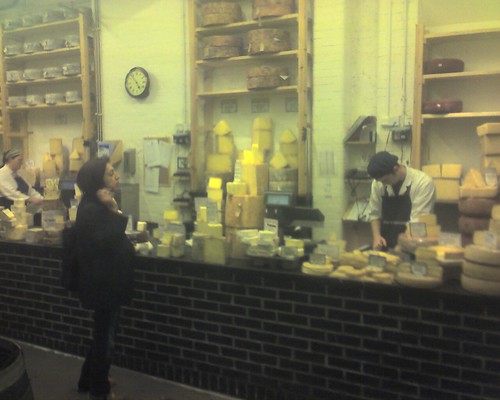
Then we wandered next door to a wonderful cheese shop, full of cheeses made by local British cheese "artisans." They had the infamous Stinking Bishop from Wallace and Gromit.

Henrik had me taste one of the cheddars. Wow! Incredible. Nice smooth fore-taste, and then an everlasting tingling sour/nutty after-taste. Never had anything like, nor do I expect to ever find anything like this in the USA.
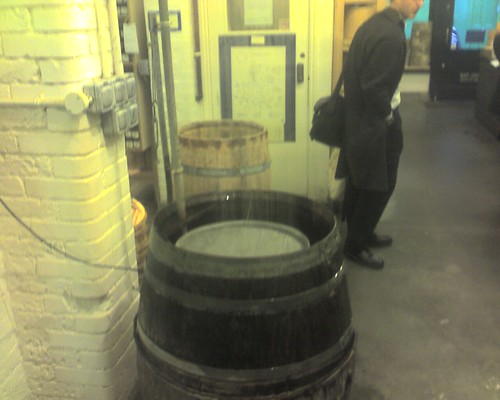
I loved the atmosphere of the shop, with its full rounds of cheese and the "cheese waterfall" that kept the shop nice and moist.
Then, round the corner to a sweet little coffee shop. I really liked the communal wood table that people shared -- you just don't see that in the USA, and I wish we'd see more.
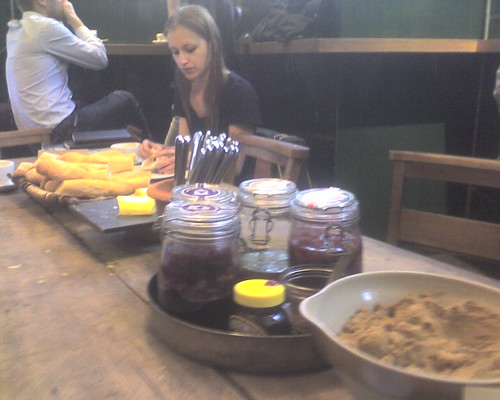
My cappucino was perfect, better than almost any I could find in the Bay Area, which is supposed to have pretty darn good coffee. There was also a hand-made chocolate truffle that was astonishingly good.
So if anyone says British food is bad, tasteless and dull, they should check out London these days. It is quite a change from some of my first visits to London, where the food was just ghastly. Elizabeth credits this to the EU, which allows for more cross-pollination from the Continent...
One last thing to notice: those little clips hanging below the table at the coffee shop.

What are those for? Obvious, says Elizabeth: to hang your purse from, so they won't get stolen. Now that's a cool idea...
Our first stop was a great little tea shoppe where we had fruit scones with clotted cream and jam, little tea cakes, and incredible, delicious Earl Grey tea.
Then we wandered next door to a wonderful cheese shop, full of cheeses made by local British cheese "artisans." They had the infamous Stinking Bishop from Wallace and Gromit.
Henrik had me taste one of the cheddars. Wow! Incredible. Nice smooth fore-taste, and then an everlasting tingling sour/nutty after-taste. Never had anything like, nor do I expect to ever find anything like this in the USA.
I loved the atmosphere of the shop, with its full rounds of cheese and the "cheese waterfall" that kept the shop nice and moist.
 |  |  |
Then, round the corner to a sweet little coffee shop. I really liked the communal wood table that people shared -- you just don't see that in the USA, and I wish we'd see more.
My cappucino was perfect, better than almost any I could find in the Bay Area, which is supposed to have pretty darn good coffee. There was also a hand-made chocolate truffle that was astonishingly good.
So if anyone says British food is bad, tasteless and dull, they should check out London these days. It is quite a change from some of my first visits to London, where the food was just ghastly. Elizabeth credits this to the EU, which allows for more cross-pollination from the Continent...
One last thing to notice: those little clips hanging below the table at the coffee shop.
What are those for? Obvious, says Elizabeth: to hang your purse from, so they won't get stolen. Now that's a cool idea...
Eep! -- Blogger in German from Heathrow
I am in the Heathrow Airport, and when I go to my Blogger page, it presents everything in German. Automatically. Isn't that special. I checked the Google FAQ and it says I need to set my default language to English in my browser. But it's already set to English.
I finally found this blog by Amit Agarwal that says I have to remove my temp folder and then set my default language at http://www.blogger.com/language.g. Sheesh! It would be nice if this were documented, rather than me having to search for a blog to do it.
I finally found this blog by Amit Agarwal that says I have to remove my temp folder and then set my default language at http://www.blogger.com/language.g. Sheesh! It would be nice if this were documented, rather than me having to search for a blog to do it.
Monday, August 20, 2007
David Duffield's Workday ERP System Uses In-Memory DB and Metatags
Very interesting note from Nicholas Carr about what David Duffield is up to these days.
http://www.roughtype.com/archives/2007/08/the_end_of_erp.php
Detecting the version of the Java VM you're in
This source code comes from the Derby source base. Very useful in cases where you want to load a particular class or do other things based on which VM you are running in. In Derby's case this is used to load the appropriate JDBC driver.
Friday, August 17, 2007
Book Recommendation: Overcoming Jet Lag

I'm going to Prague next week for work, so I'm pulling out this great book that my ex-boss gave to me, called Overcoming Jet Lag.
It is based on research done by the government for travelling officials, and it has a very easy-to-follow program based on principles of the internal clock that they uncovered: light and dark, diet, caffeine, and activity. I've used it before for my trips to Norway, and they have really worked. Highly recommended.
Tips for migrating a MySQL database to Derby/Java DB
A more and more commonly asked question on the Derby user list is "how do I best migrate my database from MySQL to Derby".
A very useful way to do this is through DDLUtils, a very nice utility that lets you export a database schema from one database and create it in another. Here is the MySQL page from DDLUtils.
But I also thought I'd share what looked like a very useful email from one person who did it. Note the interesting tips about non-standard JDBC that worked in MySQL but which Derby did not accept.
>If you don't mind - what were your top three pains when moving from
>MySQL to Derby?
Glad to, if it will be of any interest, although the problems were
probably a result of our* own inexperience and naivity.
1. We used DdlUtils to do the migration, did the conversion form
MySQL to xml ok, but then encountered errors on conversion to Derby.
These threw us initially because they related to primary keys not
being unique, but eventually we realized that this was because
MediumInt is only supported in MySQL and the conversion changed it to
a Small integer. I guess we should have inspected the xml schema more
carefully. I had consulted the page:
http://db.apache.org/ddlutils/databases/mysql.html
And my one suggestion here is that the conversion table on that page
should include the recasting of mediumint - presumably an oversight.
2. The other problems arose at runtime after apparent successful
conversion, and also arose from the non-standard nature of MySQL.
There were three aspects of the java code of my app that Derby took
exception to. One was a JDBC ResultSet method (first()) I had used in
a hack to check for empty tables. It turned out Derby didn't like
this and made me use some JDBC2 method for scrolling the table. It
also wouldn't allow a finally{} clause for closing a connection that
it already handled itself (easy enough to remove) and wouldn't allow
a faulty SQL query that MySQL had ignored (typo of GROUP instead of
ORDER - for the correction of which I thank it).
So the moral is perhaps that Derby is to MySQL as Java is to Perl -
it won't tolerate the sloppy habits you had become accustomed to. :-)
(Apologies to the Perl community)
A very useful way to do this is through DDLUtils, a very nice utility that lets you export a database schema from one database and create it in another. Here is the MySQL page from DDLUtils.
But I also thought I'd share what looked like a very useful email from one person who did it. Note the interesting tips about non-standard JDBC that worked in MySQL but which Derby did not accept.
>If you don't mind - what were your top three pains when moving from
>MySQL to Derby?
Glad to, if it will be of any interest, although the problems were
probably a result of our* own inexperience and naivity.
1. We used DdlUtils to do the migration, did the conversion form
MySQL to xml ok, but then encountered errors on conversion to Derby.
These threw us initially because they related to primary keys not
being unique, but eventually we realized that this was because
MediumInt is only supported in MySQL and the conversion changed it to
a Small integer. I guess we should have inspected the xml schema more
carefully. I had consulted the page:
http://db.apache.org/ddlutils/databases/mysql.html
And my one suggestion here is that the conversion table on that page
should include the recasting of mediumint - presumably an oversight.
2. The other problems arose at runtime after apparent successful
conversion, and also arose from the non-standard nature of MySQL.
There were three aspects of the java code of my app that Derby took
exception to. One was a JDBC ResultSet method (first()) I had used in
a hack to check for empty tables. It turned out Derby didn't like
this and made me use some JDBC2 method for scrolling the table. It
also wouldn't allow a finally{} clause for closing a connection that
it already handled itself (easy enough to remove) and wouldn't allow
a faulty SQL query that MySQL had ignored (typo of GROUP instead of
ORDER - for the correction of which I thank it).
So the moral is perhaps that Derby is to MySQL as Java is to Perl -
it won't tolerate the sloppy habits you had become accustomed to. :-)
(Apologies to the Perl community)
An old neighbor ends up in Arbil, Iraq
A neighbor of mine (well, he recently moved to Virginia) has ended up doing microfinance consulting with a bank in Arbil, Iraq. He's been sending us amazing missives about his life in the compound. They're in MS Word format, and I'm trying to convince him to turn it into a blog (maybe he doesn't have good enough Internet access for that).
Anyway, I thought I'd share his latest note.
Anyway, I thought I'd share his latest note.
Friday 1 PM
Hi everyone,
We work Sunday through Thursday so today is my day off and I slept in. It is approximately 112 degrees outside. I wanted to address the security issue. I’m getting some inquiries and people are wondering if I am in harm’s way.
Search the internet for a good map of Iraq and look at the top of the country. Kurdistan is sometimes confused with the "northern provinces" and the media continues to not distinguish between ethnic Kurdistan and the northern provinces. Mosul is violent and is up north, yes, but way east over near the Syrian border. Kirkuk is dangerous and there are lots of "incidence" down there and that is why we never entered the city. Even though the micro finance bank that I am consulting for operates there, no westerners in my parent organization enter the city. Everyone thinks that after the November election ( here ); Kirkuk will be ethnically cleansed and all the Arabs that Sadam moved in, will be kicked out…. or whatever. The Kurdish paramilitary is ready and they want the city back as well as the oil.
Anyway, Kurdistan is the three or four provinces that form a little icecap across the top of Iraq and border Turkey and Iran. The nasty genocide that occurred two days ago, for example, was outside of true Kurdistan but the area is obviously still populated by Kurds. The distinction is critical to understand, just because some bombs go off, and it is "up north" and some Kurds die, does not mean it is in Kurdistan. This may seem like trivia but I am depending on it. This city, Erbil, has a ten foot moat, or ditch, dug all the way around it to stop vehicles from entering cross terrain. The only way in is on the paved road, through multiple checkpoints guarded by the Kurd Army and the paramilitary. Voila ! No ethnic Arabs allowed. Period.
Nothing is perfect, and that is why I cannot leave the compound. It ( the compound ) is in a suburb of Erbil somewhere near the airport, and is occupied by a variation of religion that I am not sure of, I think there are Christians here or something. The suburb itself is surrounded by walls with watchtowers and guards. I live in a compound within the suburb that, as you already know, has blast walls, only one vehicle gate in and a different one out. The road to the gate has concrete diversions so an approaching car has to go really slow or it will crash. Everyone stops at the gate and the guards run a mirror under 360 degrees of the car, then the sniffer dog does it again. All supervised by Triple Canopy staff ( Google “Triple Canopy” and you can see the level of security that is provided to westerners ) No bombs allowed ! Worst case scenario is that somehow a person gets in past the gate and starts shooting up the place. They would last about one second. There are literally hundreds of armed people here including heavy duty westerners ( South African mercenaries ), not just the Kurds. Or, if someone drove close enough to the suburb, they could touch off some mortar rounds, but that would be so inaccurate that I don't even think of it.
Sorry for all the details, but information can cause relaxation, and that is what I am trying to convey. After all, there were drive by shootings almost every night on the commute path I took through north Oakland when I came back from the bank in Fremont. One of our friends was held up twice on the foot path between the BART station and his house in North Berkeley. So “safe” is a relative term.
It's noon and I am leaving the house to get lunch. Tonight I am hoping to get a security guy and go out of the compound for dinner. If not, then I will stay here, locked up like a caged rat. There is a big citadel about a mile away ( in the suburb ) and it old and famous. Maybe I can include that in my adventure if and when I can arrange an outing.
Best Regards to all
How to upgrade a Derby/Java DB database
With the recent release of Derby 10.3, it's relevant to ask - what happens to the database you created with an older version when you upgrade Derby or Java DB?
Well, Derby is focused on ease of administration and embedded use, and this includes seriously painless upgrade.
There are two types of upgrade: soft upgrade and full upgrade.
With soft upgrade, you can use a new driver to work with a database created under a previous version, but older drivers will still be able to work with the database too -- the database itself is not upgraded to the newer version/format.
This is convenient if you want to just try things out, or if you have a mixed environment where some users are still using older versions of the driver.
The drawback of this approach is that if there are new features in the newer version that rely on a new database format or new system metadata, etc., then you can't take advantage of those new features. For example, Derby 10.3 has added features for security, SQL, and administration that won't work with an older database.
That is where full upgrade comes in.
You don't need to do anything crazy like export all your data, create a new database, and recreate your tables and load your data. All you have to do is set the "upgrade" property to "true" when you connect to the database.
There are two ways to do this. You can set it as a property directly in the URL, e.g
Well, Derby is focused on ease of administration and embedded use, and this includes seriously painless upgrade.
There are two types of upgrade: soft upgrade and full upgrade.
With soft upgrade, you can use a new driver to work with a database created under a previous version, but older drivers will still be able to work with the database too -- the database itself is not upgraded to the newer version/format.
This is convenient if you want to just try things out, or if you have a mixed environment where some users are still using older versions of the driver.
The drawback of this approach is that if there are new features in the newer version that rely on a new database format or new system metadata, etc., then you can't take advantage of those new features. For example, Derby 10.3 has added features for security, SQL, and administration that won't work with an older database.
That is where full upgrade comes in.
You don't need to do anything crazy like export all your data, create a new database, and recreate your tables and load your data. All you have to do is set the "upgrade" property to "true" when you connect to the database.
There are two ways to do this. You can set it as a property directly in the URL, e.g
"jdbc:derby:travel;upgrade=true"or you can add it as a property when you get the connection, e.g.
One important caveat: if you have created a database with a non-GA version of Java DB you can not upgrade it. This is because there is no commitment to support upgrade from what is basically an experimental database. All this mean is, please don't deploy a production solution using Java DB with a beta version of Java DB.
  String dbURL = "jdbc:derby:travel";
  Properties connProps = new Properties();
  connProps.put("upgrade", "true");
  Connection conn = DriverManager.getConnection(dbURL, connProps);
Thursday, August 16, 2007
Larry Ellison: Open Source has no value in and of itself
From an interview with Larry Ellison:
Regarding future challenges, Ellison dismisses open source as a threat to Oracle.
"Open source is not something to be feared. Open source is something to be explained. Open source wins not because it's open and not because it's free. Open source wins only when it's better," he says.
To me this is another example of Oracle trying to address open source by dismissing it. Of course people only choose something because it is better. But Larry doesn't acknowledge that open source is inherently better because it is open and free.
When it is open, it allows for innovation. When it is open, it prevents you from getting locked into a single vendor. Both OEMs and customers trust it because it is not controlled by someone who may be a competitor either in business or politics. When it is free, it delivers significant price/performance benefits.
Larry goes on to say
the purchase price of software is only about 10 percent of the total cost of ownership of software. So even if the software is free, the most you can save is 10 percent off. Now the question is, what are your other costs of developing applications, of running applications on a daily basis, of dealing with problems when they occur? We think that Oracle is absolutely very competitive with open source
I think what Larry is saying here is that open source, if it is poor quality, gives you longer-term higher costs in terms of day-to-day maintenance. But I don't know if there is any data that shows that PostgreSQL or MySQL is not as stable or reliable as Oracle. And here again he is missing the value of open source: the community makes open source more reliable over time, because there are more eyeballs and more people making fixes. It's true for security, and it's true for quality.
My general feeling is, Larry is trying to pooh-pooh open source, because his customers are looking very closely at lower-cost and independent solutions. So Oracle's job is to dismiss and scare and keep their customers from taking open source databases seriously. But if I were Oracle, I'd be checking my rear-view mirror, because history has shown that open source goes where you never expect it would go: operating systems, applications servers, office suites, and, yes, enterprise databases.
Regarding future challenges, Ellison dismisses open source as a threat to Oracle.
"Open source is not something to be feared. Open source is something to be explained. Open source wins not because it's open and not because it's free. Open source wins only when it's better," he says.
To me this is another example of Oracle trying to address open source by dismissing it. Of course people only choose something because it is better. But Larry doesn't acknowledge that open source is inherently better because it is open and free.
When it is open, it allows for innovation. When it is open, it prevents you from getting locked into a single vendor. Both OEMs and customers trust it because it is not controlled by someone who may be a competitor either in business or politics. When it is free, it delivers significant price/performance benefits.
Larry goes on to say
the purchase price of software is only about 10 percent of the total cost of ownership of software. So even if the software is free, the most you can save is 10 percent off. Now the question is, what are your other costs of developing applications, of running applications on a daily basis, of dealing with problems when they occur? We think that Oracle is absolutely very competitive with open source
I think what Larry is saying here is that open source, if it is poor quality, gives you longer-term higher costs in terms of day-to-day maintenance. But I don't know if there is any data that shows that PostgreSQL or MySQL is not as stable or reliable as Oracle. And here again he is missing the value of open source: the community makes open source more reliable over time, because there are more eyeballs and more people making fixes. It's true for security, and it's true for quality.
My general feeling is, Larry is trying to pooh-pooh open source, because his customers are looking very closely at lower-cost and independent solutions. So Oracle's job is to dismiss and scare and keep their customers from taking open source databases seriously. But if I were Oracle, I'd be checking my rear-view mirror, because history has shown that open source goes where you never expect it would go: operating systems, applications servers, office suites, and, yes, enterprise databases.
Code For Freedom in India
Sun India is having an open source coding contest for university students across India called Code For Freedom - in honor of the freedom of open source and the freedom of India found 60 years ago.
From the site:
Sun Microsystems is happy to announce the Code For Freedom contest where students across India contribute to the technologies that are empowering the participation age. Participating in this contest will provide you with precious industry experience while still learning in college. And there is more. We in turn reward you for your valuable contribution in taking the first steps towards the open source movement.
For more information, see http://in.sun.com/communities/univ/codeforfreedom/
From the site:
Sun Microsystems is happy to announce the Code For Freedom contest where students across India contribute to the technologies that are empowering the participation age. Participating in this contest will provide you with precious industry experience while still learning in college. And there is more. We in turn reward you for your valuable contribution in taking the first steps towards the open source movement.
For more information, see http://in.sun.com/communities/univ/codeforfreedom/
Happy 60th Independence Day for India

This week celebrates 60 years of independence for India. I have always, always been struck with the way that India obtained its independence. Here in America, we fought with gun and musket; in India, it was fought completely with non-violent means. As always, India is giving the world deep and profound teachings.
Many people complain about our jobs being taken to India. But I know for a fact that Indians have been a huge component of the technical revolution from the beginning. And I want to honor and thank all of the contributions from the great Indian community.
I also want to thank India for giving me personally a vast and deep ocean of wisdom from which I can draw. Great statements such as tat tvam asi ("Thou Art That") and chittam mantraha ("The mind is mantra") have been food for years of contemplation and practice.
And the Indian people - sweet, kind, patient, funny, hard-working, passionate, disciplined. I want to thank and honor all of my Indian friends and colleagues.
Happy Independence Day!
An Earth Without People -- an interview with Alan Weisman

A great interview with Alan Weisman, who has a book out which predicts what would happen if humans were to disappear tomorrow. I've always wondered what it would be like if/when nature takes over.
NetBeans 6 will be dual-licensed with GPLv2+Classpath and CDDL
This email from Bruno Souza, community manager for NetBeans, outlines the plans to provide an EA version of NetBeans 6 that will be dual-licensed with CDDL and GPL v2 with Classpath exception. Very cool!
For more information, see the FAQ.
For more information, see the FAQ.
Cool Stuff with Sun's Cool Threads T2000 and PostgreSQL
 |  |
Thanks to Max for pointing this out. Not only is the price/performance significantly better ($26 vs $113) with the T2000/PostgreSQL vs HP/Oracle, but the T2000 delivers 1 1/2 times higher performance per watt. I love the DB licensing cost of $0 for PostgreSQL.
Wednesday, August 15, 2007
Roumen's Wiki Rant
Roumen hits the same frustration that I did about varying Wiki formats. Someone please save us all...
Alex Bunardzic » Resource Oriented Architecture
Alex Bunardzic presents a series of blogs on the concept of Resource Oriented Architecture, or ROA. He is emphasizing the fact that a resource and its representation are two different things, and a model of web-based programming that embraces this.
http://jooto.com/blog/index.php/category/resource-oriented-architecture/
Tuesday, August 14, 2007
java.net Forums : Please stop promoting new frameworks ...
An interesting forum thread discussing the problems of too many frameworks and too much complexity . I really liked evickroy's comment about how easy it is to deploy Java WebStart apps. I wouldn't mind seeing more of that...
http://forums.java.net/jive/thread.jspa?messageID=230579&tstart=0#230579
DamnHandy : » Where VMWare Fusion Shines Over Parallels Desktop
One blogger's take on VMWare Fusion vs. Parallels. Fusion is looking pretty attractive...
http://www.damnhandy.com/2007/08/13/where-vmware-fusion-shines-over-parallels-desktop/
Tim Bray prognosticates and navel gazes
A great blog, particularly his post-script. Here's one smart techie with his thoughts on the future. Interesting comments on Erlang.
http://www.tbray.org/ongoing/When/200x/2007/08/13/Prognostication
The Secret Diary of Steve Jobs: My lunch with Fester
I am sooo glad this guy is still writing. This one is just a gem. Siooma!
http://fakesteve.blogspot.com/2007/08/my-lunch-with-fester.html
Monday, August 13, 2007
If you want to get scared, talk to scientists

I am a subscriber to Science News, and I always learn at least one new cool thing in each issue. The July 21 edition had an article where scientists have uncovered that England was separated from the rest of Europe by a single mega-flood when a huge lake from the melting ice of the last ice age burst its banks. Sorry, you have to be a subscriber to read this, but the New Scientist has a for-free article on this.
There are many examples of sudden massive geologic and ecological change like this. Another megaflood I learned about yesterday from my brother was the one from another ice-age lake bursting that carved out the Channeled Scablands in Washington. This flood came all the way from Montana.
Then there are the super-volcanos that cause mass extinctions and the comet and asteroid hits, including the one that eliminated dinosaurs.
Interesting, but so what, right?
Well, Pa was explaining what is happening with the Greenland Ice Sheet. This sheet is the last remnant of the last Ice Age, and in some areas is many miles deep. And it is melting very rapidly as the melting water lubricates the sheet where it grips the rock. Many of us know this, but what isn't talked about much (at least I couldn't find anything) is how quickly this could actually happen.
According to my father, it's possible that the Greenland Ice Sheet will literally slide off the rock like snow slides off a metal roof once it melts to a certain point, and that sea levels will rise 20 feet not in 100 or 500 years but in just a few years. Moving vast populations of our coastal cities 20 feet uphill in a matter of a few years: doesn't sound like fun.
It's uncomfortable hearing these things from a fairly cynical scientist. He also made me aware of methane hydrates and the methane cycle. Methane is actually a significantly more powerful greenhouse gas than carbon dioxide. And if the oceans get too warm, vast amounts of methane currently frozen up in methane hydrates may be released, increasing global warming and releasing more hydrates and and and...
In a great book called A Short History of Nearly Everything, I read that the situation where we have temperate zones and an ice sheet is a very very rare situation for Earth. It is much more common to have a very frozen planet (at one point it was completely frozen over) or a very hot planet with no ice. It would seem we are tipping a very wobbly seesaw over to a new point of stability, one which our race may not like very much.
Erlang, the next Smalltalk?
Some interesting comments on the future of Erlang. And take a look at the comments - Scala is a Java-based parallel language? I'm sure some of you know about Scala, but I know very little, and it's time to take a look
http://thanksforallthesnow.blogspot.com/2007/08/erlang-next-smalltalk.html
Nitin Borwankar: Data 2.0: How the Web disrupts our relational database world
Some high-level but insightful perspectives about the future of data in the ever-increasingly data-intensive world of the web.
http://future.gigaom.com/2007/08/10/data-20-how-the-web-disrupts-our-relational-database-world/
Data Visualization Doesn't Have To Be Boring
My bro sent me this link of an amazing palette of interesting, attractive, informational and just cool ways to visualize data.
http://www.smashingmagazine.com/2007/08/02/data-visualization-modern-approaches
Thursday, August 09, 2007
BoingBoing: Virgin America's virgin flight
More rave reviews for Virgin America's new planes. I think Sun has an office in New York, and I have family there. I'm sure I have to go :)
http://www.boingboing.net/2007/08/08/getting_high_with_ri.html
Erlang, the next Java?
I have been wondering, as a programmer, what is coming down the pike for programmers to build applications better suited to multi-core chips. Erlang looks like a possible winner. I wonder if Sun is taking a serious enough look at it?
Derby 10.3 is an official release
The vote is in, and Derby 10.3 is now an official release. Keep your eyes out for the link on the Derby site.
http://www.nabble.com/-RESULT---VOTE--10.3.1.4-release-tf4239820.html
Academics Waking Up to Wikipedia
I'd like to see more of this: academics embracing Wiki-based knowledge bases. I know my Pa is considering a Wiki-based collaborative effort to work out some nasty details in microfossil classification.
http://opendotdotdot.blogspot.com/2007/08/academics-waking-up-to-wikipedia.html
What to Eat » Raw Milk or Raw Deal?
We do raw milk at home, and we love it. We can definitely tell the difference - it feels good going down. But Marion Mestle makes some good points here worth considering.
Wednesday, August 08, 2007
Hey, what happened to my auto-indent in NetBeans?
The last few days, I have been struggling while writing code in NetBeans, because auto-indent just disappeared. I asked for help on the nbusers list but didn't see an answer.
While walking my kid in the stroller this morning, I had a moment of illumination. When I came into work, I removed my userdir, and that fixed the problem. Magic!
Actually, removing your userdir seems to be the Magic Bullet for strange NetBeans behavior. NetBeans seems to be able to get its configuration repository mixed up from time to time, and then it starts having these little psychotic episodes like no longer indenting, or badging files that compile fine, and so on.
So, what is this "userdir" of which I speak? It's the "user directory" and it contains all the configuration environment for NetBeans for a given user. And where is this beast? Take a look at this FAQ for your answers (note that on a Mac the "About" page is not under "Help" but under the bold "NetBeans" menu on the far left).
Be aware that when you remove your userdir, you lose any configurations you have set up. You will have to re-register your app server, re-install any extra modules you installed, and so on. Perhaps there is a way to avoid this consequence, but I haven't spent the time to track it down.
While walking my kid in the stroller this morning, I had a moment of illumination. When I came into work, I removed my userdir, and that fixed the problem. Magic!
Actually, removing your userdir seems to be the Magic Bullet for strange NetBeans behavior. NetBeans seems to be able to get its configuration repository mixed up from time to time, and then it starts having these little psychotic episodes like no longer indenting, or badging files that compile fine, and so on.
So, what is this "userdir" of which I speak? It's the "user directory" and it contains all the configuration environment for NetBeans for a given user. And where is this beast? Take a look at this FAQ for your answers (note that on a Mac the "About" page is not under "Help" but under the bold "NetBeans" menu on the far left).
Be aware that when you remove your userdir, you lose any configurations you have set up. You will have to re-register your app server, re-install any extra modules you installed, and so on. Perhaps there is a way to avoid this consequence, but I haven't spent the time to track it down.
Tuesday, August 07, 2007
Jonathan Schwartz's Weblog: Sun Enters the Commodity Silicon Business
This part I didn't know: the Niagara 2 design is fully available under the GPL open source license. And we're selling this chip to anyone who wants to buy it, including our competitors. Brash, bold, creative, passionate - that's Jonathan.
http://blogs.sun.com/jonathan/entry/sun_enters_the_commodity_silicon
Global-Warming Deniers: A Well-Funded Machine - Newsweek
I've always had my suspicions, but for Newsweek, about as mainstream as you can get, to document the concerted effort to sow the seeds of doubt around global warming is chilling (sic).
Earth2Tech : Sun’s Energy Efficient Chip
Sun's announcing our new Niagara chip, with huge power savings because it has 8 cores with 8 threads each on a single chip. People are sitting up and paying attention
http://earth2tech.com/2007/08/07/suns-energy-efficient-chip/
More details on JSON support in JAXB
This one is from Jakub Podlesak, the engineer responsible for implementing JSON support in Jersey.
http://blogs.sun.com/japod/entry/json_entity_providers_in_jersey
Using JAXB to generate XML and JSON from a single HTTP method
I just read this post from Paul Sandoz on the Jersey mailing list ( Jersey is the open source JAX-RS (JSR 311) Reference Implementation for building RESTful Web services.
They've been working on using JAXB to support both XML and JSON bindings.
Paul's recent checkin allows you to annotate a single method with JAXB annotations to support JSON and XML data formats as a response.
Which format is used depends upon the accept header of the HTTP request. If there is no accept header or it is set to
Here is an example from Paul's email:
Note that this is very in line with REST principles. The response is a representation of the state, and you can get different representations of that state for the same request, depending upon what the request asks for.
Pretty darn cool - great work, guys!
They've been working on using JAXB to support both XML and JSON bindings.
Paul's recent checkin allows you to annotate a single method with JAXB annotations to support JSON and XML data formats as a response.
Which format is used depends upon the accept header of the HTTP request. If there is no accept header or it is set to
*, application/* or application/xml then you get XML. If it's application/json, then you get JSON.Here is an example from Paul's email:
@UriTemplate("/")
public class MyResource {
  @HttpMethod
  @ProduceMime({"application/xml", "application/json"})
  public JAXBBean get() {
     JAXBBean j = ...
     return j;
  }
}
Note that this is very in line with REST principles. The response is a representation of the state, and you can get different representations of that state for the same request, depending upon what the request asks for.
Pretty darn cool - great work, guys!
Monday, August 06, 2007
Open source study: Developer communities not enough for support
Matt Asay of CNet comments on a new study showing that developer communities do not provide sufficient support for production software. This ties into Sun's business model of shipping open source software for free and then charging for support.
Friday, August 03, 2007
H2 Database supports PostgreSQL ODBC driver
Now this is a very interesting move. H2 is riding on the coat-tails of PostgreSQL by supporting the PostgreSQL client/server protocol. Now they don't have to build their own ODBC driver, and get automatic PHP, Perl, TCL, etc. support through PG drivers.
http://www.theserverside.com/news/thread.tss?thread_id=46456
To niche or not to niche
James Governor quotes Anne Zelenka on the value of "niching" your blog. I like talking about just about everything, but I have to agree with my bro that posting lots of family stories and photos is going to drag down a "general reader" blog.
http://www.redmonk.com/jgovernor/2007/08/03/on-blogging-no-niche-required/
Roumen does Dilbert for NetBeans
Good ol' Roumen, having fun. He's added a Dilbert plugin for NB that displays todays Dilbert cartoon. I'm adding it to my NetBeans! :)
http://blogs.sun.com/roumen/entry/dilbert_plugin_for_netbeans
Ian Murdock and Marc Hamilton On Sun OS Strategy
Some very interesting observations about the future of operating systems, including some cool stuff about packaaging, commodity storage and 10GB Ethernet support integrated into the latest Sun chips.
Google Gears running on Windows CE powered devices
Looks like the Google Gears team is working on a port to Windows CE
http://groups.google.com/group/google-gears/browse_thread/thread/ecd9aa97b2b47de7
Google Gears Object/Relational Mapping API
Uriel Katz is making available an Object/Relational Mapping (ORM) API on top of Google Gears. Worth taking a look-see. It makes you aware of the possibilities...
http://www.urielkatz.com/archive/detail/google-gears-orm-v01/
New Dojo Offline Release That Integrates With Google Gears
More Google Gears news. Dojo Offline is a nice framework that is now ported to run on top of Google Gears. Features includes a nice offline widget, SQL support, automatic scanning of resources that need to go offline, and more. Check it out.
How to bind stored procedures to visual web components
I didn't think it was possible to bind the results of a stored procedure to a visual web component, but this short NetBeans Wiki entry shows it can be done. There 's also a promise of an article coming soon. Cool!
Thursday, August 02, 2007
Google Uses Crowdsourcing To Create Maps In India
As anyone who has lived in or visited an Indian city can attest to, mapping such city is not for the faint of heart. Back alleys, tiny streets, all wandering one into the other, most without real names or addresses. I wonder how accurate this really is.
http://radar.oreilly.com/archives/2007/08/google_uses_cro.html
Stephen O'Grady on The Potential for Online Desktop
A very cogent and detailed plus/minus analysis of the opportunities and issues around an "online desktop" model - e.g. a desktop whose software relies on and integrates online services.
Cay Horstmann's not happy with The Java DB in JDK shell game
Java DB keeps moving its location in the JDK. This has an impact on everybody relying on it, and Cay Hortsmann has something to say about it. We've had the same problem in NetBeans. I am hoping after Update 3 things will settle down.
http://weblogs.java.net/blog/cayhorstmann/archive/2007/08/a_bundle_of_joy.html
Wednesday, August 01, 2007
Xerox invents super-green paper
Claims they reduce greenhouse gas production by70% when making this paper. That's pretty impressive
Serious high tech on the new Virgin America planes
Wow - I would be happy just with the 110V plugs, but this also includes mpg playlists (that are remembered for your next flight), usb jacks for charging, satellite movies, chat and wireless internet access. Sold!
http://radar.oreilly.com/archives/2007/07/_virgin_america.html
Subscribe to:
Posts (Atom)